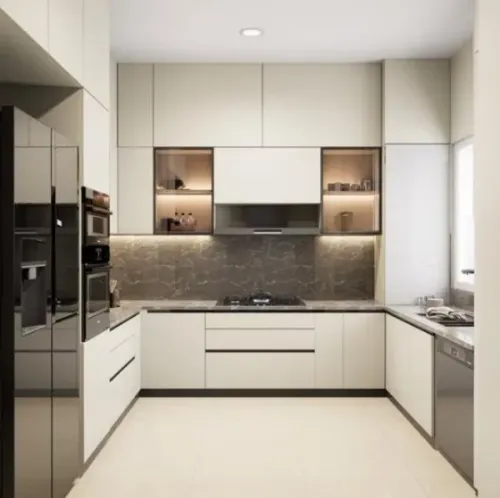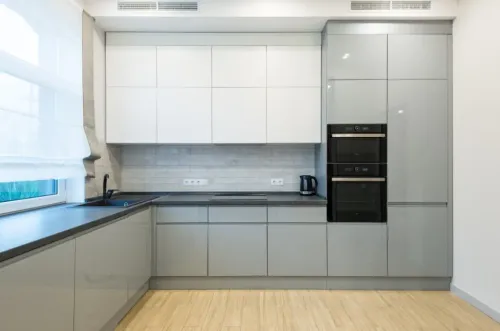
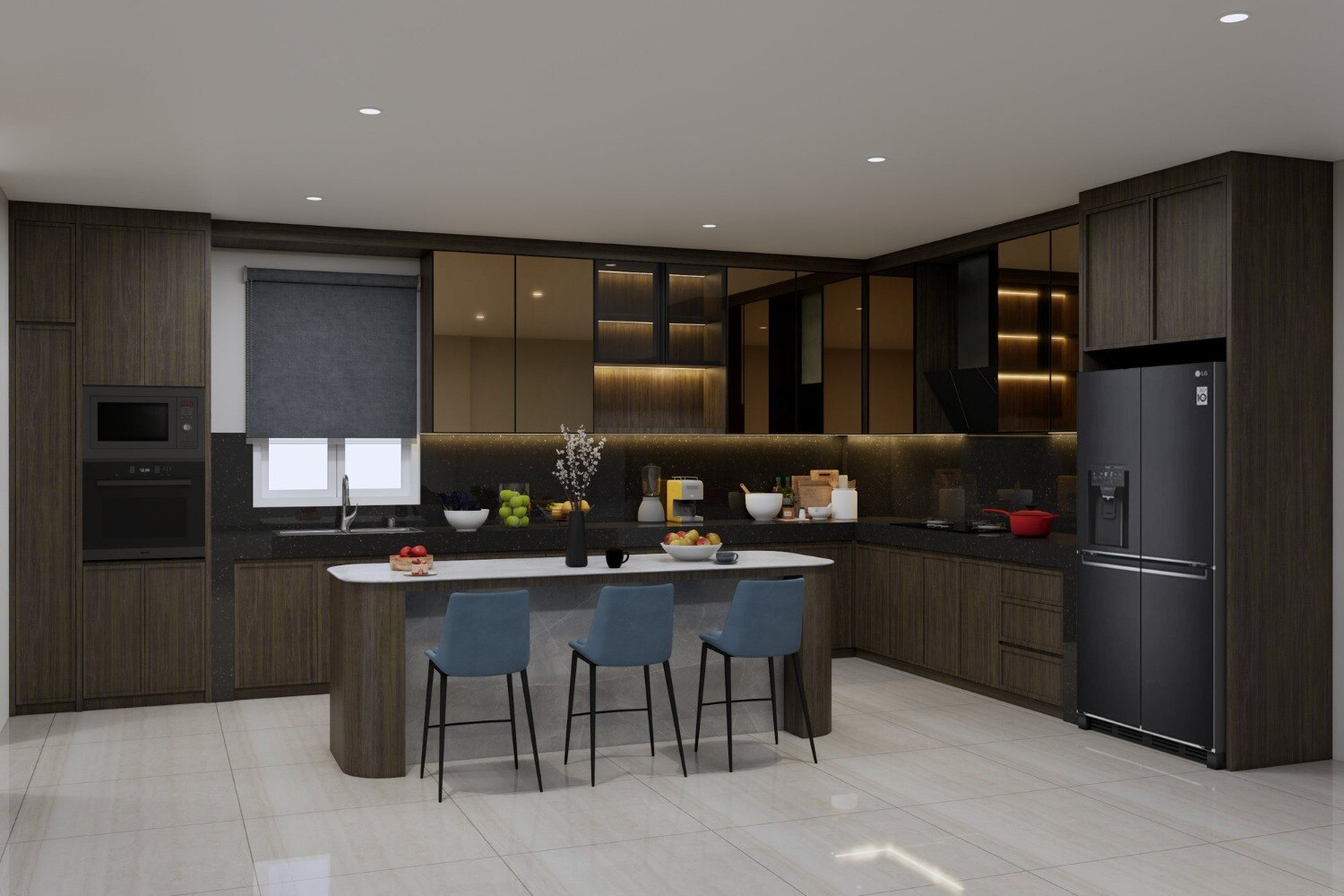
A premium acrylic kitchen is not made entirely from acrylic: its visible panels sit on a board substrate, with edges, adhesives, hardware, and moisture protection determining how well it performs. By the end, you will know how to verify the material, compare it with other finishes, prepare for a consultation, and assess whether it suits your cooking habits and apartment conditions.
Key takeaways
- Choose shutters by comparing acrylic cores, edge treatments and hardware.
- Bring measurements, appliance details, storage needs and reference images.
- Request material specifications, drawings, hardware details and exclusions before approving the quote.
- Compare acrylic with laminate, PU, veneer, glass and membrane for your kitchen’s conditions.
What are you actually buying when you choose an acrylic kitchen?
A premium acrylic kitchen has acrylic-faced shutters, not cabinets made entirely from acrylic. The sheet or panel is bonded to MDF, HDHMR, plywood, or another engineered board, so the core, adhesive, edge treatment, and hardware matter as much as the visible finish.
| Material | What you are buying | Key difference |
|---|---|---|
| Acrylic | Bonded cast or extruded sheet | Consistent reflective face; scratches often require panel replacement |
| Laminate | Decorative layer pressed onto board | Broader value and easier replacement options |
| PET | Polymer film on a board | Similar gloss in photographs; verify the actual material |
| Membrane | Vacuum-formed PVC film | Suits routed profiles; heat can lift edges |
| PU paint | Sprayed coating on board | Flexible colour selection; spray quality controls the result |
| Veneer | Natural or engineered wood layer | Grain varies; surface can be refinished |
| High-gloss PVC | Gloss polymer surface or sheet | Similar appearance; confirm composition and manufacturer |
For a premium acrylic kitchen for design consultation near me in Thane, ask for a written specification, not the word “premium.” It should name the acrylic brand or manufacturer, cast or extruded construction, sheet thickness, board grade, shutter thickness, adhesive, laser edging or matching acrylic strip, ABS/PVC edge banding, and sealing around sinks, handles, hinges, and appliances.
Inspect the sheet edge for a clean bond and request the manufacturer’s technical sheet plus a written warranty listing exclusions, including scratches, heat damage, moisture swelling, chemical cleaners, and installation faults.
Which acrylic finish and edge details will work in your kitchen?
High-gloss acrylic gives stronger colour depth and mirror-like reflection, but it also reflects uneven walls and shows fingerprints, dust, and fine scratches. Matte acrylic reduces visual maintenance, although neither finish is waterproof, scratch-proof, stain-proof, or heat-proof.
| Finish | Strength | Choose it when |
|---|---|---|
| High-gloss acrylic | Reflective, vivid, easy to wipe | You accept frequent wiping and have well-finished walls |
| Matte acrylic | Softer reflection, fewer visible fingerprints | You want a calmer appearance with less visual upkeep |
| Laminate or textured surface | Broader durability and lower maintenance | Heavy cooking, children, or frequent contact matters more than a mirror finish |
Confirm the available colour range, then check physical samples under your kitchen lighting. Ask whether matching acrylic is supplied for shutters, fillers, end panels, and tall units; mismatched side panels can make an expensive kitchen look unfinished.
- Specify laser edging, matching acrylic strips, ABS edge banding, or PVC edge banding. Inspect corners for gaps, lifting, and exposed board.
- Require sealing around sink cut-outs, screw holes, handles, hinges, appliance panels, and the bottom edges of shutters. Steam, oil splashes, and standing water still need prompt wiping.
- At an acrylic kitchen consultation in thane, request care instructions that name a soft, non-abrasive cloth and approved cleaning chemicals. Confirm temperature limits beside hobs, ovens, chimneys, and toasters, plus the appliance clearances; acrylic is not a heat shield.
- Choose laminate or a lower-maintenance textured finish when scratches, strong cleaning, heavy cooking, or moisture exposure would make daily acrylic care impractical.
How does acrylic compare with laminate, PU, veneer, glass, and membrane?
Acrylic gives the most consistent reflective surface, but appearance alone does not prove durability. Compare the complete shutter system, including the board, edge, hardware, repair method, and availability of a matching replacement panel.
| Option | Finish quality | Maintenance and repair | Cost, lifespan and replacement |
|---|---|---|---|
| Acrylic | Uniform high-gloss or matte surface with consistent colour | Easy to wipe; fine scratches and deep damage usually mean replacing the shutter | Premium cost; long service life with careful use; matching panels depend on the manufacturer |
| Laminate | Broad colours, textures, and patterns; gloss quality varies | Strong everyday value; chips are difficult to repair but replacement is widely available | Low to mid-range cost; durable; broad replacement availability |
| PU paint | Seamless painted finish with extensive colour flexibility | Wipe carefully; local touch-ups can show; spray quality controls the final result | Mid to premium cost; lifespan depends on preparation and coating; replacement colour matching can be difficult |
| Veneer | Natural or engineered grain gives warmth, but each panel varies | Can be sanded and refinished; protect it from prolonged moisture | Mid to premium cost; long life with maintenance; matching grain is not guaranteed |
| Glass | Crisp, reflective colour with strong visual depth | Easy to wipe, but handle edges and impact carefully; cracked panels need replacement | Premium cost; durable when specified correctly; replacement requires accurate sizing |
| Membrane | Smooth or routed profiles without visible paint lines | Clean gently; heat can cause edge lifting; damaged film is rarely locally repairable | Mid-range cost; lifespan depends on heat exposure; replacement availability varies |
Compare a physical sample under kitchen lighting, inspect its back and edge, and ask what happens if one shutter is damaged after installation. If you are searching for a kitchen designer near me, compare specifications and after-sales terms, not just 3D renders or colour names.
What should you bring to a premium kitchen planning consultation?
A precise plan starts with a verified site survey and an appliance schedule, not cabinet colours. Bring your measurements and appliance details, then ask the designer to confirm them on site.
1. Ask the designer to record wall-to-wall dimensions, ceiling height, beams, columns, skirting, window and door positions with opening swings, plumbing points, electrical capacity and outlets, gas-cylinder or piped-gas location, exhaust route, lift and staircase access, and building delivery rules.
2. Bring the refrigerator width and door swing, hob, chimney, oven, microwave, dishwasher, water purifier, washing-machine, and small-appliance requirements. Include preferred storage for grains, cookware, waste segregation, cleaning supplies, appliances, and daily-use items.
3. In Thane, monsoon humidity and water exposure make ventilation, sink-cabinet sealing, dishwasher-adjacent protection, and accessible plumbing connections essential. Check that leaks can be detected and repaired without dismantling cabinets.
4. With DESIGNO CASA, ask who owns site measurements and how revisions are documented when civil, electrical, plumbing, countertop, cabinet, and installation work are coordinated. Request a full-height elevation, appliance schedule, opening schedule, and service plan; a perspective render alone can hide unusable corners and blocked connections.
5. Record the agreed site visits, revision process, material samples, installation sequence, snagging method, payment milestones, and variation procedure. This written record prevents a late appliance change from becoming an expensive cabinet alteration.
What should a modular kitchen design appointment deliver before you approve a quote?
Approve a quote only after the modular kitchen design appointment produces a full-height elevation, an opening schedule, and a service plan—not just a 3D perspective. The drawings must show every shutter, drawer, lift-up unit, open shelf, filler, appliance panel, service panel, corner solution, tall unit, and overhead cabinet.
Judge corner storage by access, not by the number of compartments promised.
| Option | Access issue to check | Suitable when |
|---|---|---|
| Blind corner | Deep area can become a dead zone | You accept simple, low-cost storage |
| Corner drawers | Drawers need clear neighbouring runs | You want direct access without moving shelves |
| Carousel | Rotating shelves can waste corners | Round shelves suit your cookware |
| Pull-out | Narrow hardware reduces usable width | You need organised access to bottles or trays |
| Service void | Gives plumbers and cables working space | Maintenance matters more than maximum storage |
Check reach heights, cabinet depth, ceiling levels, skirting, ventilation gaps, appliance clearances, and door collisions. Confirm that tall units and overhead cabinets do not block windows, chimney airflow, or safe access to frequently used items.
A comparable quote must separately state:
- Carcass material and thickness; shutter material; edge treatment; hardware brand and load rating; drawer-extension type; and accessories
- Countertop, sink, faucet, electrical and plumbing alterations, delivery, installation, taxes, and warranty exclusions
Before the appointment ends, record the number of site visits, measurement responsibility, sample approval process, revision limit, installation sequence, snagging method, payment milestones, variation procedure, and replacement-panel terms. A polished acrylic shutter cannot correct poor sealing, inaccessible storage, appliance clashes, or weak installation control.
Frequently asked questions
What are you buying when you choose an acrylic kitchen?
You are buying acrylic-faced shutters bonded to an engineered board, plus adhesive, edge treatment, carcass, hardware and installation—not cabinets made entirely from acrylic.
Which acrylic finish and edge details work in a kitchen?
Choose the finish based on cleaning habits, lighting, fingerprints and visual preference, then inspect the edge banding, joins and corner treatment.
How does acrylic compare with laminate, PU, veneer, glass and membrane?
Compare each option for appearance, cleaning, scratch resistance, repairability, moisture exposure, maintenance and total installation requirements.
What should you bring to a premium kitchen planning consultation?
Bring room measurements, appliance dimensions, plumbing and electrical points, storage requirements, budget limits, preferred finishes and reference images.
What should a modular kitchen design appointment deliver before you approve a quote?
Request a measured layout, elevations, material specifications, edge details, hardware schedule, scope of work, exclusions, timeline and itemised quote.
Keywords